
Oconee Projected and Actual Dates
A projected release date is a calculation based on the sentence structure and credit assumptions that apply at the time. The South Carolina Department of Corrections uses the literal field label PROJECTED RELEASE DATE on a current state prisoner's detail report. SCDC describes it as the date the incarcerated terms are expected to be satisfied if eligible work, education, and good-time credits continue at the present rate. It can function as a max-out projection, but it is not a guaranteed exit.
An actual release date records an event that has occurred. The separate SCDC Released Inmate Search supplies a state-prison release date and release type after the person leaves SCDC custody. For someone held at the Oconee County Detention Center, the jail release record is the source for the physical event. The court order gives legal authority, yet it may not state the exact time the person left the building.
A pretrial detainee usually has no SCDC projected date. Release can turn on bond, a later court order, dismissal, or the resolution of holds. A transfer to SCDC or another agency also ends the local custody episode without placing the person in the community.
Find Oconee Projected Release Dates
Start with the custody system. The SCDC current inmate search covers people currently sentenced to and incarcerated in SCDC as of midnight the previous day. It excludes former SCDC inmates, people sentenced to county detention facilities, and people on parole, probation, or other community supervision. A failed SCDC search therefore cannot answer every Oconee County date question.
- Determine whether the person is pretrial, serving a local Oconee sentence, or serving a state sentence in SCDC. Check receiving custody if the Oconee roster no longer lists the person.
- For a current state prisoner, search by SCDC number or SID when known. Otherwise use the name fields and verify identity on the detail report.
- Read the sentence information and the exact `PROJECTED RELEASE DATE` field. Keep projected parole eligibility separate.
- For a local sentence, ask Oconee detention records for the time-computation or release record and compare it with the judgment, jail credit, and any hold.
- For a pretrial person, review the Oconee court case for bond and later orders. Do not invent a date when no sentence calculation exists.
- Confirm an expected event with the custodian and use VINE for a notification. After release, locate the actual jail or SCDC release record.
The official SCDC public search provides the state-prison route used before opening an inmate detail report.
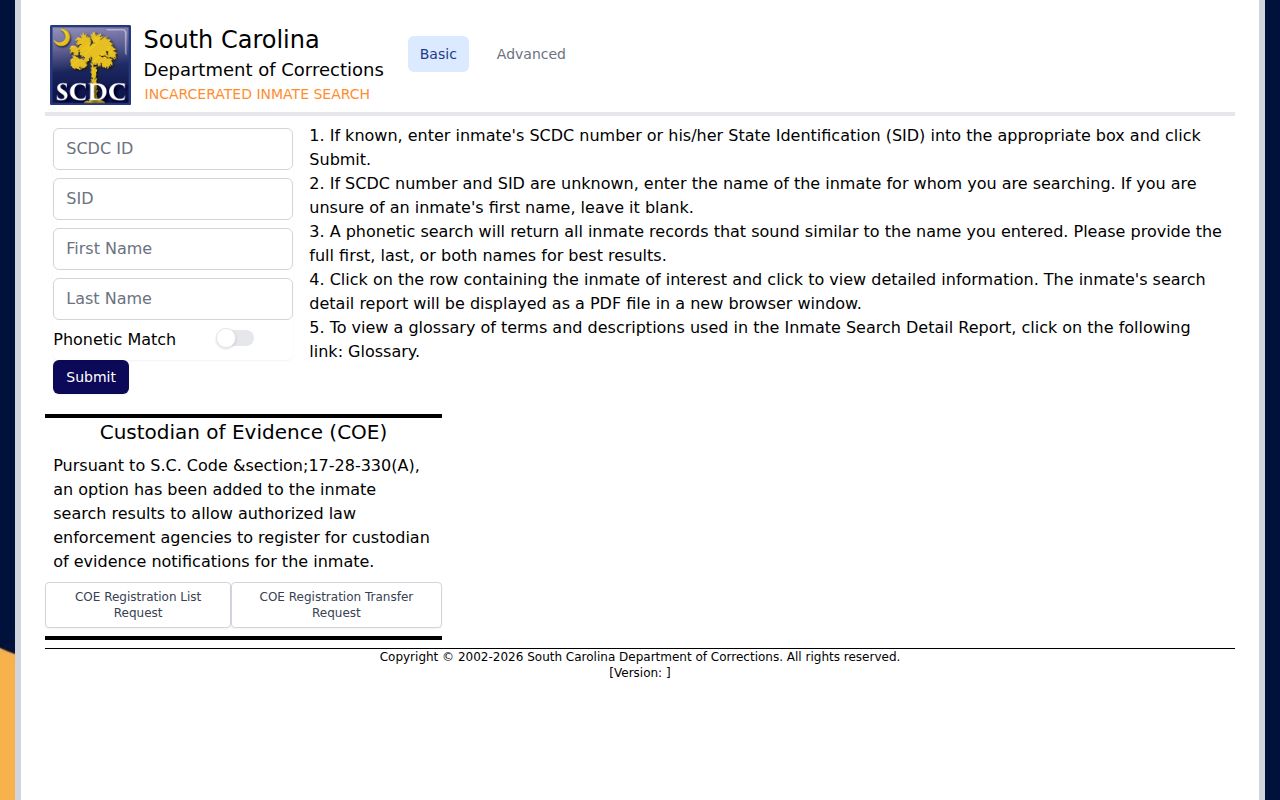
That statewide interface should be used only for the population SCDC says it covers, not for a locally sentenced Oconee County detainee.
Note: SCDC's current search is a previous-midnight snapshot, so a recent admission, transfer, or release may not yet align with another source.
Oconee SCDC Projected Date Field
The projected release field must be read with the sentence. A date may be blank or later change because of sentence structure, credit eligibility, disciplinary forfeiture, a recalculation, an additional sentence, a hold, or a legal order. The SCDC number or SID is more reliable than a name-only match, especially when several records share a common name.
Projected parole eligibility is a different field and a different clock. Eligibility means the person may be considered under the applicable law. It is not a release promise. The South Carolina parole statute contains different fractions and exclusions based on offense and sentence. Murder, armed robbery, trafficking, no-parole provisions, mandatory minimums, and other rules prevent a universal shortcut.
If parole applies, the Parole and Pardon Hearings Search accepts first and last name, SCDC number, and hearing month in stated combinations. Schedules and results become searchable about thirty days before a hearing, dates can be rescheduled, and results can be delayed. A grant still requires conditions and release processing. Confirm what followed through SCDC and SCDPPPS.
Is the parole eligibility date the day of release? No. Eligibility opens a decision process. The SCDC projected field, board action, release processing, and actual released-list entry answer separate parts of the timeline.
Oconee Release Calculator Limits
The SCDC Release Date Calculation is an educational tool for a general sentence scenario. Its own warning says it cannot calculate the release date of an inmate who has already been sentenced. It also excludes Youthful Offender Act calculations and assumes available credits within its parameters. For a real sentenced person, use the inmate's SCDC detail report or contact SCDC Inmate Records at 803-896-8531.
The official SCDC calculator source shows the inputs and warnings that define this narrow use.
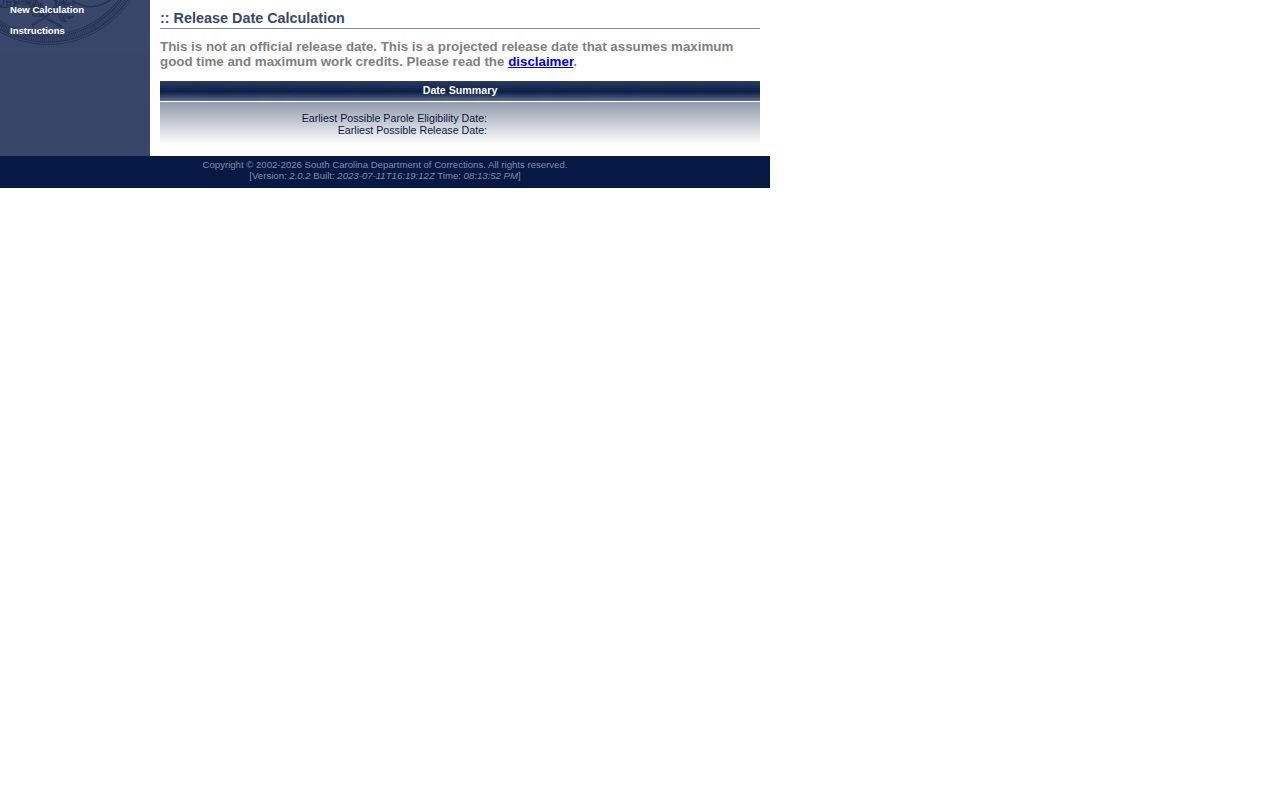
The calculator can explain a hypothetical framework, but it cannot replace the current calculation held for a named Oconee County prisoner. Do not move its result onto a jail record. A local sentence has its own statutory baseline and local application, while a pretrial case has no final sentence to calculate. Even for SCDC, offense classification and legal restrictions must be known before the credit framework can be applied correctly.
Note: The SCDC calculator is educational only; its disclaimer directs questions about an already-sentenced person to Inmate Records.
Oconee Release Credits and Floors
South Carolina credit law depends on the sentence. Section 24-13-150 sets the truth-in-sentencing floor for a no-parole offense: at least 85 percent of the actual unsuspended prison term must be served, calculated without work, education, or good-conduct credits. Credits cannot be subtracted below that floor.
Under Section 24-13-210(A), an eligible SCDC sentence that is not a no-parole offense can receive twenty days of good-conduct credit per month served. Subsection (B) provides three days per month for a no-parole offense, still subject to statutory minimums. Section 24-13-230 addresses work and education credits. Its non-no-parole framework can allow one day for each two days of qualifying activity within the annual cap, while no-parole sentences use the smaller monthly rate and combined cap. Misconduct can cause forfeiture.
These rules explain why the SCDC detail report uses a projection. It assumes continued earning at the present rate, then changes when the underlying facts change. An offense classification, mandatory minimum, concurrent or consecutive sentence, or added legal order can matter more than a simple count of calendar days.
- Good-conduct credit
- A sentence deduction earned under the applicable statute and subject to forfeiture.
- Work or education credit
- A statutory credit tied to qualifying activity within stated limits.
- No-parole offense
- An offense within the statutory classification that triggers special release limits.
- Detainer
- A request or hold that may send the person to another authority after one custody term ends.
Oconee County Jail Date Computation
A person sentenced to a local detention facility follows a different baseline. Section 24-13-210(C) provides one day of good-conduct deduction for every two days served for faithful compliance, subject to local forfeiture. That statute does not establish how Oconee officials calculate a named person's date. The jail time-computation record is still needed.
Ask the Oconee County Detention Center, at 864-638-4228, which existing record states the sentence start, credit for time served, good-conduct application, hold, and calculated end. Detention Administration is listed at 864-638-4105. Use the OCSO records route for the existing jail computation or release record. Compare it with the judgment because concurrent or consecutive terms, jail credit, and later orders can change the arithmetic.
For a court record, use the South Carolina case-records search and the Oconee Clerk of Court. A bond order may explain why a pretrial person can be released, but it does not prove the physical exit time. Likewise, a sentence order gives the legal term, while the jail record shows how the custodian applied credit and recorded release. No published Oconee policy states a fixed weekend or holiday release rule, exact release-processing time, or public family waiting location. Those details should come from the detention center.
Note: Local good-conduct law supplies a baseline, not the final computation for a named person or proof that release occurred.
Why Oconee Release Dates Change
A projected date can move because the legal or factual inputs move. Some changes adjust the sentence calculation. Others do not alter the nominal end date but prevent release into the community. Read each factor in the record system that controls it.
| Factor | Possible effect | Source to check |
|---|---|---|
| Lost good-time credit | Moves the projected date later | SCDC or jail calculation record |
| New sentence or correction | Changes the term or sentence structure | Court order and custodian record |
| Detainer or hold | May cause transfer instead of community release | Release export and receiving agency |
| Parole decision | May authorize a community phase, subject to processing | Board result, SCDC, and SCDPPPS |
| Credit recalculation | Can move the projection earlier or later | Current SCDC detail or jail computation |
| Disciplinary forfeiture | Reduces earned credit when authorized | Custodian's sentence record |
A detainer is a key distinction. Leaving Oconee County Detention Center for SCDC, federal custody, immigration custody, or another county is a transfer, not a community release. The same principle applies when an SCDC sentence ends but another authority takes custody.
Confirm Oconee Release Dates
Use South Carolina VINE for notification, then use the custodian's record for proof. After an inter-agency transfer, search the new agency record and register again. The Oconee VINE inmate check explains registration methods, phone PIN acknowledgment, and the separate formal SCDC notification path.
For an actual state-prison event, search the SCDC released list by date range and choose OCONEE in the county selector. Record the release date and type, then use Export to inspect detainer information. The county field is not defined on the page as a release facility, so results should be described as SCDC releases returned under the Oconee filter, not releases from the county jail.
If the released list cannot resolve an older or unclear state record, submit a narrow SCDC FOIA request for the existing release or discharge record. Include the SCDC ID and the fields sought. SCDC's legal-information page notes that South Carolina FOIA applies while records excluded by Section 30-4-40 remain withheld.
For a completed local event, request the OCSO booking-and-release record with the exact custody episode and compare it with the court order. For a supervised release, check SCDPPPS. Keep projected release, parole eligibility, actual release, and supervision discharge as separate dates. The broader Oconee County released-inmate records path shows how those sources connect.