
Oconee 72-Hour Release Status
No official Oconee County Sheriff's Office webpage or sheriff-linked portal reviewed through August 1, 2026 supplies a rolling 72-hour release list. The agency provides a current-inmate search explanation, the current Zuercher roster, and an arrest-report archive. The roster shows who remains listed in jail custody. The reports system concerns arrests. Neither one becomes a former-inmate feed when a three-day date range is selected.
A three-day inquiry should therefore lead with OCSO records. Give the office precise start and end timestamps and ask for existing release-log entries in that period. Then reconcile those entries with the court docket and VINE. A missing roster name cannot supply the release date, the legal reason, or the next destination. It may reflect a transfer rather than a return to the community.
Search Oconee Three-Day Releases
Choose one continuous interval. For example, a Monday inquiry could start at the same clock time on Friday and end at the present check time. Calendar dates alone can blur the beginning and end of a rolling period. OCSO may hold a log by agency time, while court and notification updates follow their own processing clocks.
- Write down the exact three-day start and end, including times. State whether the request covers all OCDC releases or one custody episode.
- Check the current roster only to identify people still listed. Do not infer why another name is absent.
- Submit the interval through the OCSO FOIA route. Ask for existing release entries with disposition and destination fields.
- Review the Oconee case through the state court search. Note bond, dismissal, sentence, time-served credit, or later orders.
- Compare South Carolina VINE events from the participating agency and check any named receiving jail, SCDC, BOP, or ICE destination.
The Oconee County 24-Hour Releases page fits a same-day rolling interval. Use this three-day method when the desired period crosses several calendar dates.
Oconee Three-Day Record Fields
There is no verified OCSO online table whose columns can be promised. The useful fields below belong in the request for an existing booking-and-release event or release log. Some material may be redacted or exempt, and the office need not create a custom report that it does not maintain.
| Field to request | Why it matters across three days |
|---|---|
| Full name | Identifies each person tied to a custody-ending event. |
| Booking number and date | Keeps separate custody episodes from being merged. |
| Actual release date and time | Places the event inside the exact start and end boundaries. |
| Release type or disposition | Distinguishes bond, court order, sentence completion, discharge, and transfer. |
| Authority for release | Points to the matching court or agency record. |
| Receiving agency or destination | Separates community return from continued custody elsewhere. |
| Hold or detainer notation | Warns that another agency may have assumed or sought custody. |
Ask for electronic delivery and keep the date range narrow. For a single person, include a known birth date, booking number, or case number only as needed to distinguish the correct record. Names alone can join the wrong people or bookings.
Note: The Oconee jail record supplies physical release timing, while a court order explains authority but may not show the exit time.
Oconee Weekend Release Checks
A three-day range is useful around weekends and holidays because it collects several days of events into one defined request. It does not solve every timing problem. Court entries, VINE events, jail processing, and receiving-agency intake may appear on different clocks. A bond order entered during the span can precede the physical exit, and a receiving record can follow the local transfer.
Use the wider window as a catch-up tool. Keep the exact boundaries beside every result, then compare source times rather than forcing all events onto one date. If an OCDC record says transfer, follow that destination even if the current local roster no longer lists the person. If the court docket shows a dismissal but the jail record lists another hold, the hold may explain why community release did not occur at once.
A holiday also does not create a special public feed or a guaranteed delay. No OCSO source states a release-feed cadence, online archive period, or fixed time when a former detainee would appear. The three-day request is valuable because it defines the desired records, not because the sheriff publishes a standard weekend report.
Why Oconee Releases Disappear
Oconee's Zuercher portal is expressly configured for current inmates. The display includes mugshot, name, race, sex and age, arrest date, held-for agency, and hold reasons. Its filters include an “In Custody On” date and arrest date. It has no release-date field and no former-inmate view. The separate report search is an arrest-report archive.
That data design makes it impossible to rebuild a reliable 72-hour release list by comparing the live roster on different days. Removal does not reveal whether the person bonded out, served the local term, transferred, entered SCDC, moved to another jail, or became subject to federal or immigration custody. Restricted records and name differences can also affect what a search returns.
The official current roster shown below demonstrates the live-custody fields available to the public.
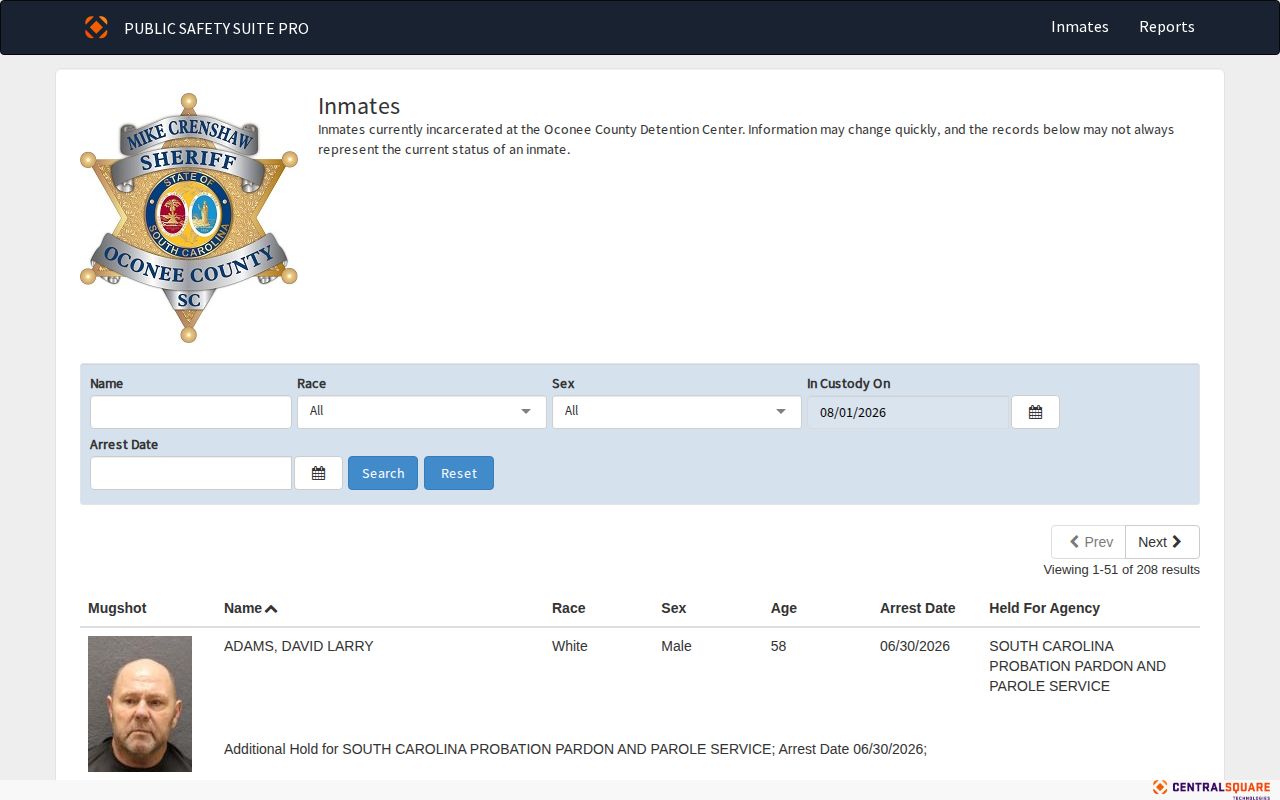
Its value is positive custody confirmation, not a history of everyone who left during the prior three days.
Request Oconee Release Logs
Use the OCSO form rather than Oconee County administration's general form. County instructions expressly route sheriff and jail records to the sheriff. OCSO's form lists 415 South Pine Street, while the detention center's current address is 300 South Church Street. Call before visiting. The Detention Center line is 864-638-4228, and Detention Administration is 864-638-4105.
Posted sheriff fees are $18.96 per hour for search, retrieval, and redaction, $0.50 for each physical page, and $5 for media. A deposit can be up to 25 percent. The stated determination period is 10 business days, or 20 for records more than 24 months old. After a favorable determination, production is ordinarily due within 30 calendar days, or 35 for older material, subject to payment and exemptions.
South Carolina FOIA also requires documents identifying people confined in jail, detention, or prison during the preceding three months to be available for inspection or copying unless exempt. That rule does not require OCSO to maintain an online three-month archive or publish every release field. Request the actual record series and ask the custodian about retention.
Note: Statutory response periods govern record handling; they do not turn a records request into an instant weekend release feed.
Oconee State Release Range
The SCDC Released Inmate Search can accept a three-date range with OCONEE selected. That result concerns people released from South Carolina state prison and associated with the SCDC county field. It is not an Oconee County Detention Center release log, and the county choice does not prove that OCDC was the releasing facility.
SCDC results include an ID, name, sex, race, age, sex-offender indicator, release date, release type, and county. Export adds SID, victim and detainer indicators, and most-serious-offense data. Release type gives the next clue. PROBATION, SUPV RE-ENTRY, and COMMUNITY SUPV point toward SCDPPPS. A detainer indicator warns that leaving SCDC may have led to another custody system.
The official state release form appears below through its SCDC source.
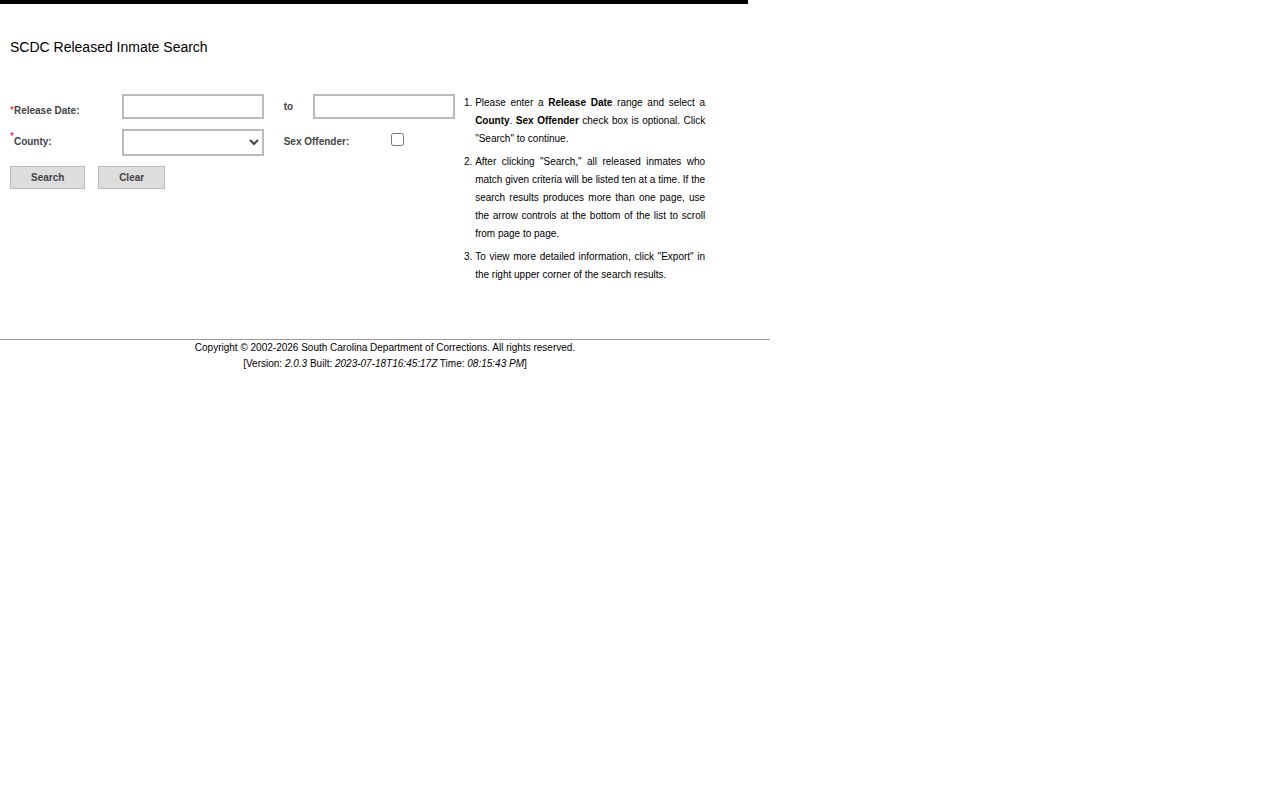
Use it to check state-prison events across the same calendar dates while keeping state and county custody records separate.
Verify Oconee Release Destinations
VINE is a notification and status channel for participating adult county detention, SCDC, and SCDPPPS records. It can add a custody-change event to the three-day timeline. It is not a certified release sheet. A person must be searched again and notification registration renewed after an agency transfer, because an Oconee event may precede a new SCDC episode.
The court docket supplies the legal case path. It may show bond, sentence, dismissal, or another order that outlives the jail roster entry. For federal sentenced custody, use the BOP locator. For federal pretrial custody, rely on the federal docket and USMS records because there is no matching public USMS locator. ICE has its own locator and limits, so an absent ICE result is not conclusive.
- Released to the community
- The event and destination support return outside custody, though court or supervision conditions may remain.
- Released to supervision
- Jail or prison custody ended while parole, probation, monitoring, or supervised reentry continued.
- Transferred
- Another jail or agency accepted custody. This is not a community release.
- Roster removal only
- The current display changed without a positive record explaining what came next.
Keep each source's “as of” time with the result. The OCSO event, court record, VINE notice, and receiving-agency entry answer different questions. Together they establish whether a three-day match was a local release, a conditional release, or a transfer. The Oconee County released-inmate search maps those sources when the inquiry concerns one named person instead of a three-day group.