
Oconee Parole and Probation Compared
Parole and probation can both place a person under community rules, but they begin in different ways. The South Carolina Department of Probation, Parole and Pardon Services FAQ defines probation as a community sentence ordered by a judge. A person may receive probation without serving a state-prison term. Parole is permission from the Board of Paroles and Pardons for an eligible state prisoner to finish part of a sentence in the community. The prior custody record matters when reading either status.
For Oconee County, SCDPPPS supervises both categories. Its record should be compared with the source that created the status. A probation entry should match the sentencing order in the Oconee court case. A parole entry should align with the SCDC release record and, when needed, the parole hearing result. Neither status proves the exact moment someone walked out of the Oconee County Detention Center or an SCDC institution.
| Feature | Parole | Probation |
|---|---|---|
| Who authorizes it | South Carolina Board of Paroles and Pardons | Sentencing judge |
| Prior prison term | Follows an eligible SCDC prison term | May begin without a state-prison term |
| Best confirming records | SCDC release, hearing result, and SCDPPPS status | Court order and SCDPPPS status |
| End point | Completion or formal discharge, unless revoked | Completion or formal discharge, unless revoked |
- Parole
- Board-approved completion of an eligible prison sentence in the community.
- Probation
- A court-ordered community sentence with stated conditions.
- Discharge
- The formal end of the supervision term or sentence obligation.
- Absconder
- A person alleged to have stopped reporting or left supervision without permission.
Verify Oconee Post-Release Supervision
The official starting point is the SCDPPPS Offender Search. It accepts first name, last name, SID number, county, and year of birth. Valid searches include first plus last name, SID alone, first or last name paired with year of birth, or a county paired with an identifier or name. The data represents the previous day, so a same-day change may not appear yet. Use identifiers to avoid combining two people with similar names. A public match supports the supervision status shown, but does not supply the physical release time. A no-result can mean supervision ended, a search field was wrong, or the daily update has not caught up.
- Gather the full name, year of birth, and SID when lawfully available. Note whether the custody event involved Oconee County Detention Center or SCDC.
- Run one valid field combination in the SCDPPPS search. Narrow the query if several people share the same name.
- Read the listed supervision category and source date. Do not treat the result as an exact jail or prison exit record.
- For parole, compare the result with the SCDC released-inmate entry and the official hearing outcome. For probation, compare it with the Oconee sentence or order.
- Call the Oconee SCDPPPS office when a prior-day result is missing, stale, or unclear. Ask about the proper official record rather than unpublished case notes.
The official search interface helps show which details must match. The SCDPPPS search source provides the following view for statewide supervision queries.
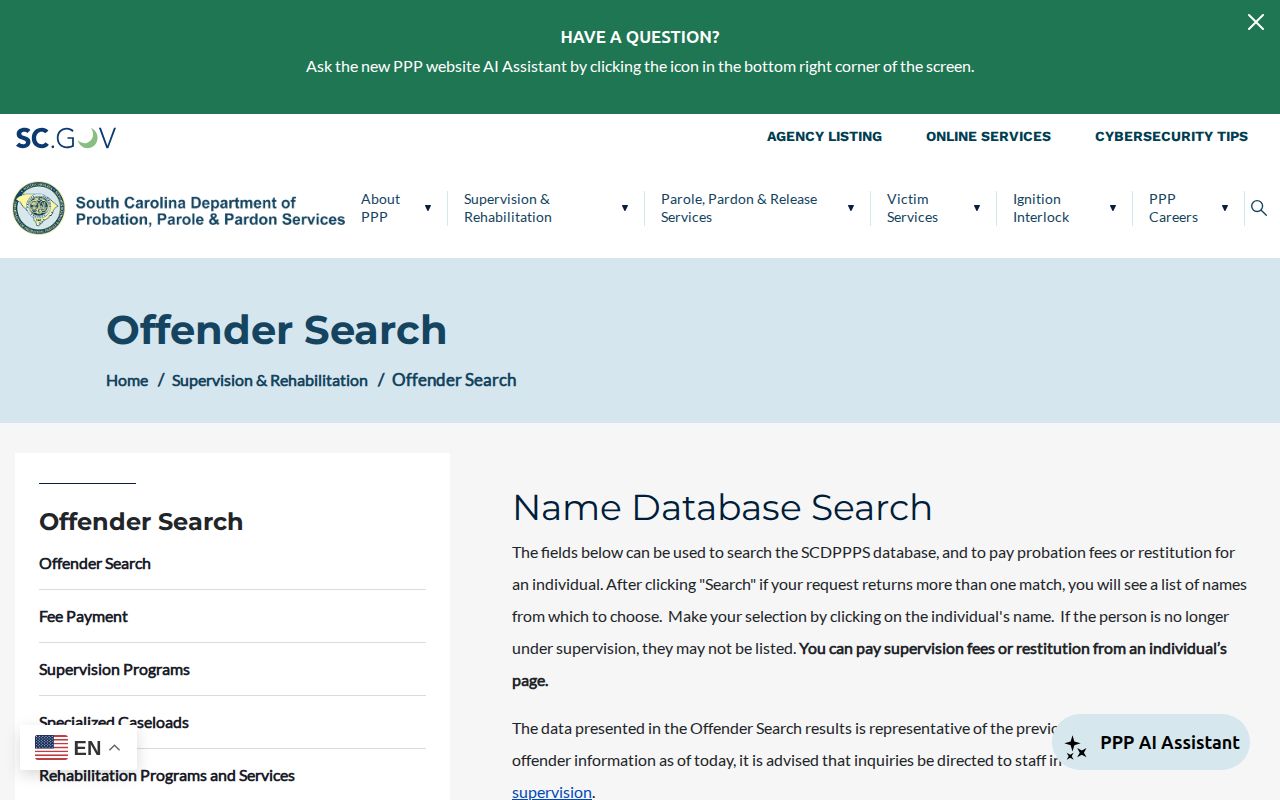
That form is for active public supervision data, not a complete history of every Oconee County release or discharge.
Note: SCDPPPS states that its public offender-search data represents the prior day, so local confirmation may be needed after a recent change.
Oconee Supervision Search Fields
Field choice changes what the search can establish. The SID is the strongest public identifier when known because it avoids many name collisions. Name and year of birth can narrow a common name. County is useful with another accepted field, but it should not be read as proof that the Oconee County Detention Center was the releasing facility.
| Field | How to use it | Limit |
|---|---|---|
| First and last name | Use together as a valid search pair | Aliases and shared names can produce uncertainty |
| SID number | Search alone or pair with county | Must belong to the correct person |
| Year of birth | Pair with first or last name | Not a unique identifier by itself |
| County | Pair with SID, first name, or last name | Does not prove a specific release site |
| Data date | Read the prior-day snapshot in context | Same-day action may lag |
When the displayed category is community supervision or supervised reentry, compare it with the release type in the SCDC export. A `COMMUNITY SUPV` or `SUPV RE-ENTRY` release type signals a next-stage SCDPPPS check, not unrestricted discharge. South Carolina law can require community supervision at the applicable release point for a no-parole offense under Section 24-21-560.
Oconee Supervision Office Details
Oconee County has a named office in the SCDPPPS county directory. Its live directory separates parole, probation, community supervision, supervised reentry, and other supervision categories. That makes the local office the right fallback when a public result from the prior day does not answer a current question. Staff can route a request to the correct record or unit, subject to disclosure limits.
Oconee County SCDPPPS Office
203 Booker Drive
Walhalla, SC 29691
Phone: 864-638-4255
Fax: 864-638-4264
The official Oconee County office listing is the best source for current contact details. Public category counts on that directory are dated snapshots. They are not annual release totals and should not be used to estimate how many Oconee residents left custody.
For a formal public-record request, SCDPPPS provides a FOIA request form and the email address FOIA@ppp.sc.gov. Ask narrowly for an existing public record of supervision type and start, end, or discharge date. Official-duty information can be privileged under Section 24-21-290, so case notes and every condition should not be assumed public.
Note: The local office verifies supervision; the jail, SCDC, and court remain the sources for physical release and sentence records.
Oconee Reentry After Release
Supervision is only one part of returning to Oconee County. OCSO Judicial Services describes cooperation with Oconee Addiction Recovery and Solutions, while its Life after Lock-Up account documents certificate programs offered with Tri-County Technical College to state inmates housed at OCDC. The account also describes a route for participants to continue their education after release. These are local navigation points, not a promise that any person qualifies now.
The Oconee Addiction Recovery and Solutions contact page gives direct provider information. OCSO's Life after Lock-Up article supplies the local program context. A person on probation, parole, or supervised reentry should check proposed participation against current supervision terms and obtain needed approval from the responsible officer.
Release from the building can coexist with firm rules. Education or recovery support does not alter a court order, supervision category, or discharge date. Provider eligibility and capacity may also change, so current details should come from the provider.
Oconee Supervision Violations and Absconders
Conditions vary by the controlling order and supervision type. At a high level, a person may have reporting, location, payment, treatment, travel, or conduct requirements. A claimed violation does not erase the historical release. It starts a separate supervision process that can lead to added controls, a warrant, a hearing, or return to custody when authorized.
SCDPPPS publishes a selected Most Wanted Offenders list with `AT LARGE` or `CAPTURED` status, a photo, county, description, and original offense. It is not a full absconder database. Absconding means an alleged failure to remain in contact or comply with supervision, not a new conviction. Never approach a listed person. Emergencies go to 911; the listed confidential tip line is 1-888-761-6175.
South Carolina VINE may also reflect adult SCDPPPS status and notification events. It is useful for a custody or supervision change, but the supplying agency's record controls the exact legal meaning. Re-register after a transfer because an Oconee custody event may be followed by an SCDC record.
Note: An at-large label is a selected agency alert, not a full account of the person's case or a final court finding.
Oconee Supervision Discharge Records
Supervision ends through formal completion or discharge, not merely because a name stops appearing in a public search. Successful completion can satisfy the supervision term or sentence obligation. Revocation can instead return a person to custody. A parole grant also is not the physical release event because conditions and release processing must still occur.
For parole history, the Parole and Pardon Hearings Search accepts first and last name, SCDC number, and hearing month in stated combinations. Schedules and results become searchable about thirty days before a hearing, dates may move, and posted results may lag. A granted result should be followed by the SCDC released list and SCDPPPS status to learn what occurred.
For the final supervision record, request the existing SCDPPPS discharge date or status. Pair it with the Oconee court order for probation or the SCDC release and board result for parole. The broader Oconee County released-inmate search path explains how jail, court, SCDC, VINE, and receiving-agency records fit together when the question extends beyond supervision.
A denied parole result can lead to another hearing in one or two years depending on the offense date and classification, according to SCDPPPS. The Board also has authority to revoke, modify, or rehear parole within its role. Those actions belong to the parole record, while a later return to custody belongs to the receiving custodian's record. Keeping the records separate preserves the sequence from prison term, to board decision, to release processing, to supervision, and finally to discharge or revocation.