
Understanding Oconee County Released Inmates
A person leaves the Oconee County Detention Center's current roster when that custody episode ends in the local system. That change alone does not say where the person went. The Oconee County Sheriff's Office may have released someone on bond, under a court order, after time served, or at the end of a local sentence. It may also have transferred the person to the South Carolina Department of Corrections, another jail, federal authorities, or immigration custody. A death or a restricted record can also remove a name without a community release.
The release type determines which record comes next. OCSO keeps the local booking and release event. The court keeps the bond, sentence, dismissal, or other legal authority. SCDC records a transfer into state prison and later state-prison discharge. The South Carolina Department of Probation, Parole and Pardon Services, known as SCDPPPS, covers state community supervision. VINE can supply an event notice from a participating agency. Evidence is strongest when the custody event and the next official record agree.
- Discharge
- The custodial part of a sentence has ended, though supervision may remain.
- Time served
- The court credits enough time in custody to satisfy a local custodial term.
- Detainer
- Another agency asks to hold or transfer the person when the first custody basis ends.
- Expungement
- A legal process that removes, seals, or destroys qualifying state records.
Oconee County Release Types
Oconee County released inmates do not all share one legal outcome. Bond ends physical jail custody while the criminal case continues. Electronic monitoring can permit a person to leave the building under restrictions. A local sentence may end through time served or completion. A dismissal can resolve a charge, but another charge or hold may still control custody. Parole follows an eligible state-prison term, while probation is a court-ordered community sentence and may occur without a prison release.
| Recorded outcome | Meaning | Best next record |
|---|---|---|
| Bond or recognizance | Local jail custody ends while the case remains open. | Oconee court order and OCSO release event |
| Electronic monitoring | The person leaves jail with court restrictions. | Court order and administering agency |
| Time served or discharged | The custodial term is satisfied. | Jail or SCDC discharge and sentence |
| Probation or parole | Community supervision applies. | SCDPPPS, plus SCDC data for parole |
| Transfer or detainer | Custody shifts instead of ending. | Receiving jail, SCDC, BOP, USMS, or ICE |
| Dismissed or acquitted | A charge ends without conviction on that count. | Court disposition and physical release event |
A label such as RELEASED, PROBATION, SUPV RE-ENTRY, or COMMUNITY SUPV should be copied exactly from an SCDC result. Each points to a different next step. A detainer flag matters because departure from one facility may still lead directly to another agency's custody.
Oconee County Release Record Fields
A useful Oconee County release-record request identifies the exact custody episode. Full name, date of birth or booking number, booking date, and facility help prevent a false match. The core event fields are the date and time custody ended, release reason or disposition, releasing facility, authority for release, and destination or receiving agency when a transfer occurred. Charges, case numbers, bond status, sentence, time-served credit, detainers, and supervision can connect that event to other records.
| Field | What it shows |
|---|---|
| Name and booking identifier | Links the event to the correct person and custody episode. |
| Booking and release date/time | Marks the local period of confinement and when it ended. |
| Release type or reason | Distinguishes bond, sentence completion, supervision, transfer, or another outcome. |
| Authority and case number | Points to the court order, sentence, or agency basis. |
| Detainer or receiving agency | Shows whether another custodian took control. |
| Supervision information | Identifies parole, probation, supervised reentry, or community supervision. |
Not all fields are public, and no single portal shows all of them. Oconee's live roster displays identity, arrest, holding, and mugshot details, but no local release date or former-inmate view. SCDC's released list shows a state release date, type, and county. Its export adds SID, victim, detainer, and most-serious-offense fields. Those are distinct records from different custodians.
Request Oconee County Release Records
The direct route for a sheriff or jail record is the OCSO FOIA page and agency form. Oconee County's general administration route specifically sends Sheriff and Clerk requests to those offices. Ask for an existing record, not an answer to a question. A narrow request for the booking and release sheet, exact custody dates, release type, authority, and receiving agency is easier to identify.
- Identify the person and custody episode with full name, booking number if known, booking date, and a narrow date range.
- Request the booking and release record, including actual release time, disposition, authority, holds, and receiving agency.
- Ask separately for the booking photograph when needed for purpose-neutral identification and still public.
- Choose electronic delivery and be ready to approve a lawful deposit for extensive work.
- Compare the response with the court docket, VINE event, SCDC record, or receiving agency.
OCSO posts labor at $18.96 per hour, physical pages at $0.50 each, and media at $5. A deposit of up to 25 percent may be required. The form states a determination period of 10 business days, or 20 for records older than 24 months, followed by production in 30 calendar days, or 35 for older records, after approval and subject to payment and exemptions.
OCSO records route: the form lists 415 South Pine Street, while current detention pages use 300 South Church Street. Call 864-638-4228 or 864-638-4105 before an in-person visit.
Oconee County Release Record Laws
The South Carolina Freedom of Information Act defines public records broadly, including photographs, but access remains subject to exemptions and redaction. Fees cannot exceed actual cost. Labor must use the lowest-paid qualified employee, electronic records carry no per-copy charge, and a deposit cannot exceed 25 percent. Section 30-4-30(D)(3) requires recent documents identifying people confined during the preceding three months to be available for in-person inspection and copying unless exempt.
The statute does not require OCSO to operate a three-month online archive or reveal every field. Juvenile, investigative, privacy, security, sealed, and expunged material may be limited. Retention depends on the record series, such as a jail log, booking register, release report, photograph, or incident record. Ask the custodian to identify the South Carolina archives schedule rather than treating web-display time as official retention.
Electronic Monitoring After Oconee Release
Oconee Bond Court is located at the detention-center site, but court authority and physical custody remain separate records. The 2023 OCSO report counted 151 arrestees released under electronic monitoring as a bond condition, compared with 114 in 2022. Those figures show why an Oconee County release can mean leaving the building while restrictions continue. They are not counts of all releases.
The court order supplies conditions and legal authority. The jail record supplies the custody event. A monitoring or supervision record may supply later status. A person can therefore be released from OCDC without being fully discharged from the case. Do not treat the time a bond order was filed as the exact jail exit time.
Oconee Release Processing in 2023
The county-hosted OCSO report states that the detention operation processed 3,081 arrestees in calendar year 2023, down from 3,124 in 2022. These are workload figures. They are not a release total, a unique-person count, or a measure of community return. One person may have more than one custody episode, and a processed person may transfer rather than leave custody.
Labels matter beside each Oconee figure. Processing volume gives scale for records work. The monitoring count illustrates a specific release condition. Neither number shows how many Oconee County released inmates entered the community without restrictions.
Oconee Release Expungement Limits
The Tenth Judicial Circuit uses a written local expungement application. Applicants are told not to send payment until the solicitor verifies eligibility and fees. The form estimates 12 to 16 weeks or more. Expungement can remove or seal qualifying government records, but the circuit warns that it cannot erase independent news stories or third-party Internet publications. A missing public index entry after expungement does not prove that no custody episode once existed.
Under South Carolina Code sections 17-1-40 and 17-1-60, specified booking, mugshot, fingerprint, and detention records may be held under seal after qualifying outcomes. The pay-to-remove rule is narrower than a general right to erase every image. It bars a covered payment model and provides a documented request path for defined outcomes. Restrictions, exceptions, and the final disposition all matter.
Find Oconee County Released Inmates
The correct search begins with custody type. Oconee County jail records, state-prison records, and federal records do not share one database. Record the spelling, identifier, custody episode, source, and time checked. Match by booking number, SID, SCDC ID, federal register number, or A-number when available. A name-only match can join different people or separate bookings.
- Check the OCSO roster only to learn whether the person is now listed in local custody. A missing name is not proof of release.
- Search the Oconee court route for bond, disposition, sentence, time-served credit, dismissal, or later orders.
- Request OCSO's booking and release record for the exact custody episode.
- Check South Carolina VINE and note the supplying agency, status, and event time.
- If transfer is possible, search current SCDC custody, the receiving county, BOP or USMS records, and ICE.
- For a former state prisoner, use the separate SCDC Released Inmate Search, then verify supervision through SCDPPPS.
Roster absence is only a lead. A person may have entered another jail, SCDC, federal custody, or ICE rather than returning to the community.
The Oconee County 24-Hour Releases page explains the same-day fallback because OCSO does not publish a verified local release feed. For one named person, the release event and next official record are stronger evidence.
Search SCDC Oconee Release Records
SCDC operates two official systems. The ordinary SCDC inmate search is a prior-midnight snapshot for people currently sentenced to and incarcerated in state prison. It excludes released people, county-sentenced detainees, parole, probation, and other community supervision. For a person who left SCDC, use the separate SCDC Released Inmate Search. Enter a release-date range, choose OCONEE, and read the date with its release type.
| SCDC tool | Search fields | Correct use |
|---|---|---|
| Current inmate search | SCDC number, SID, or name | Confirm state custody and view sentence detail or a projected date. |
| Released inmate search | Date range, county, optional registry check | Find a positive SCDC release event, date, type, and county result. |
| Released export | Uses the release result set | Review SID, victim, detainer, and most-serious-offense fields. |
The county column is not proof that OCDC released the person. SCDC does not define it as arrest county, release facility, conviction county, or intended residence. Describe a match only as an SCDC release returned under the Oconee filter. Check SCDPPPS when supervision follows and the receiving custodian when a detainer appears.
The official SCDC released search shows the state-prison scope before the captured interface.
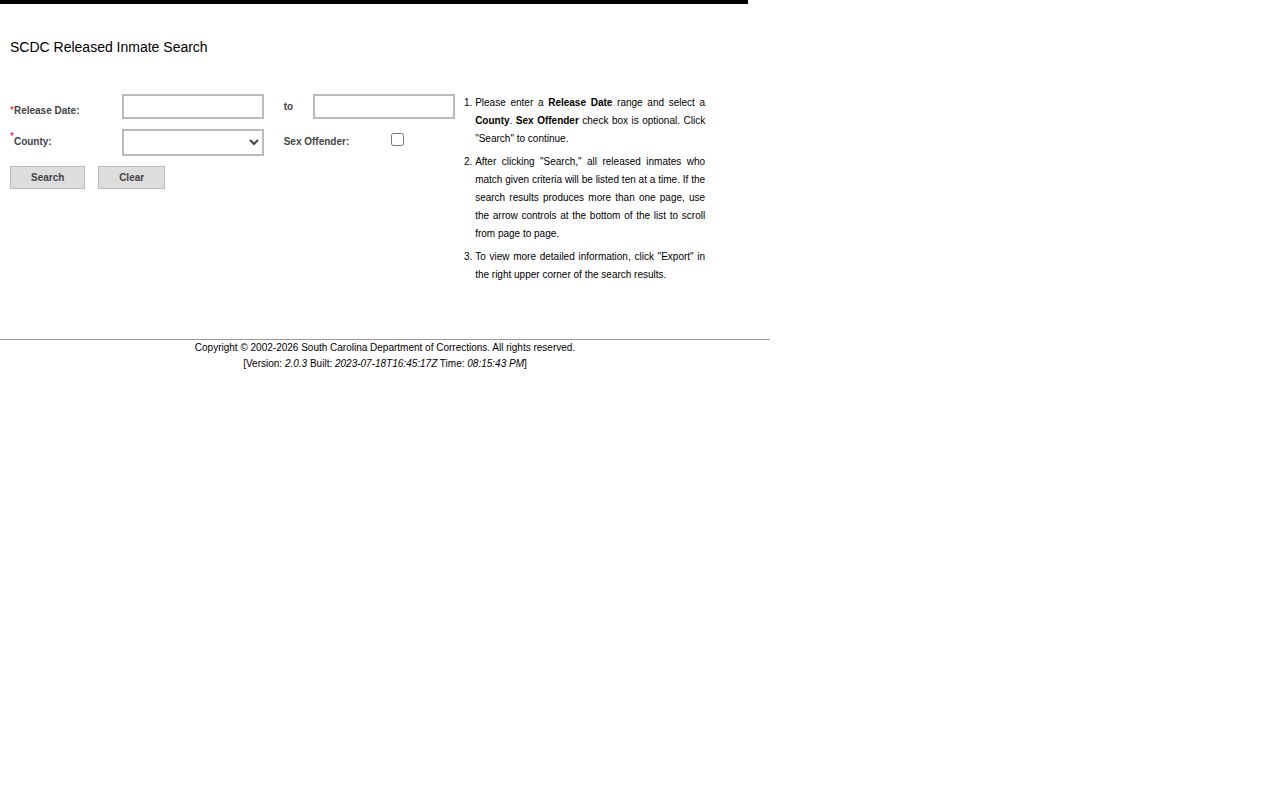
Its date and county controls distinguish SCDC discharge data from the sheriff's local, current-only roster.
Check Oconee County Recent Releases
OCSO publishes a current-inmate explainer, a Zuercher roster, and an arrest-report search. No verified sheriff-hosted view for releases in the past 24 or 72 hours was found through August 1, 2026. The roster includes a mugshot, name, race, sex and age, arrest date, held-for agency, and hold reasons. It has no release date or former-inmate filter. The reports portal is an arrest archive, not a release log.
For a local interval, ask OCDC or OCSO for release events between exact timestamps. Request the name, booking identifier, release time, disposition, and receiving agency, subject to redaction. Then compare court activity and VINE. An SCDC one-day or three-day query under the Oconee filter is a state-prison alternative only. It is not an Oconee jail list.
The OCSO inmate-search explainer leads to the current portal. The captured roster shows why its scope must remain separate from a released-person search.
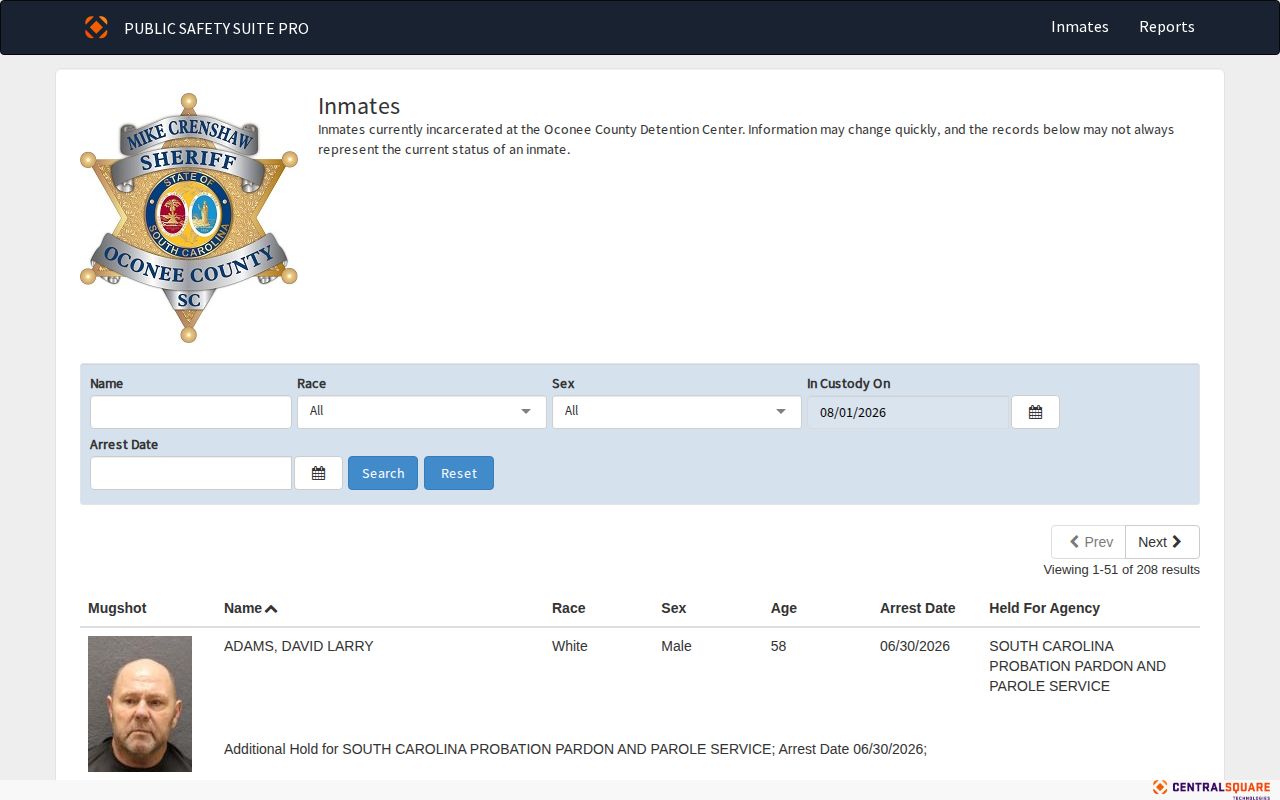
A positive entry supports current local custody at the source time. A disappearance does not identify what happened next.
Verify Oconee Post-Release Supervision
The SCDPPPS Offender Search covers parole, probation, community supervision, supervised reentry, and other listed state categories. Its public data represents the previous day. Search fields include first and last name, SID, county, and year of birth in permitted combinations. A positive result supports the supervision shown, but not the physical time the person left jail or prison. A missing result may reflect spelling, daily lag, or the end of supervision.
Parole is Board-authorized completion of an eligible prison sentence in the community. Probation is imposed by a judge and does not require a prior prison stay. Community supervision can be mandatory at release for a no-parole offense. The Oconee office at 203 Booker Drive in Walhalla is the proper local fallback when the prior-day result is unclear.
Oconee Reentry After Release
OCSO Judicial Services describes cooperation with Oconee Addiction Recovery and Solutions. A sheriff article also describes Tri-County Technical College certificate work for state inmates housed locally and a route to return after release to finish. These are local navigation points, not promises that a program is open or available to every released person.
Contact providers to confirm current services and eligibility. The OARS contact page is a direct provider route. Reentry support does not prove custody status, so keep the release record, supervision record, and service discussion separate.
Cross-Agency Oconee Release Alerts
South Carolina VINE covers adult county detention, SCDC custody, and SCDPPPS supervision. Users can search and register for telephone, email, text, or TTY alerts. A chosen four-digit PIN acknowledges automated calls, which can repeat for up to 48 hours. After an OCDC-to-SCDC or other transfer, find the new agency record and register again. VINE is an event system, not a certified release record.
Federal and immigration records use different routes. The BOP Inmate Locator can show a release date or released status for many former federal prisoners. USMS controls many federal pretrial detainees, so a docket and Marshals record may be needed before BOP designation. ICE's locator covers some current detainees and recently released people within its limited window. No result is definitive.
Compare Oconee Custody and Release
Each official source answers a narrow question. Use a positive record and its timestamp. Four absences, not found in OCDC, current SCDC, active SCDPPPS, or a public court case, do not combine into proof of community release.
| Source | Still in custody | Released or transferred |
|---|---|---|
| OCSO roster | Positive listing supports current Oconee custody. | Absence gives no destination. |
| OCSO release record | Not a live locator. | Can state exit time, reason, and receiving agency. |
| SCDC current search | Prior-midnight state-prison snapshot. | Explicitly excludes former inmates. |
| SCDC released search | Not a custody roster. | Shows state release date and type. |
| SCDPPPS | Not jail or prison custody. | Shows listed supervision as of the prior day. |
| BOP or ICE | Federal or immigration scope. | Shows status within agency limits. |
Can a released person still face restrictions? Yes. Bond conditions, electronic monitoring, parole, probation, community supervision, supervised reentry, and registration duties can follow physical release. Read the release type and separate order or supervision record.
Verify Oconee Release Across Courts
OCDC holds the physical custody event. Bond Court operates at the detention-center site. The Circuit 10 Clerk and Public Index hold General Sessions material, while magistrate and participating municipal systems may hold summary matters. The physical custodian and disposition custodian can differ even when jail and court functions are close.
Use the South Carolina Case Records Search to reach Oconee's index. Review charges, events, disposition, sentence, bond, and later orders. The Clerk says the public computer index starts in 1994; older indexes require research books. A docket explains authority, while the OCDC record establishes physical exit time and destination.
Oconee Releases into ICE Custody
OCSO began an ICE Warrant Service Officer program in August 2025. Trained detention deputies may serve federal warrants when someone bonds out or completes a local sentence. ICE then has up to 48 hours to assume custody. An OCSO case report documents an OCDC-to-ICE handoff. “Released from Oconee” can therefore mean release to ICE, not return to the community.
The local release record should identify the receiving agency when recorded. Then use the ICE Online Detainee Locator System or its help line. The locator is not a permanent release archive and excludes some categories. Keep the local custody end and immigration custody result as two linked events.
Oconee County Detention Facility
The research found one locally verified adult detention facility: the Oconee County Detention Center. OCSO operates it for county agencies, municipalities, the South Carolina Highway Patrol, and the South Carolina Department of Natural Resources. A local release may lead to the community under conditions, the end of a local sentence, state supervision, or transfer.
No separate city jail, state prison, federal prison, or ICE detention facility was identified inside Oconee County. Municipal police can arrest a person, and a municipal court can hold the case record, while OCDC remains the physical jail. SCDC, BOP, USMS, and ICE are downstream systems, not extra Oconee facilities.